
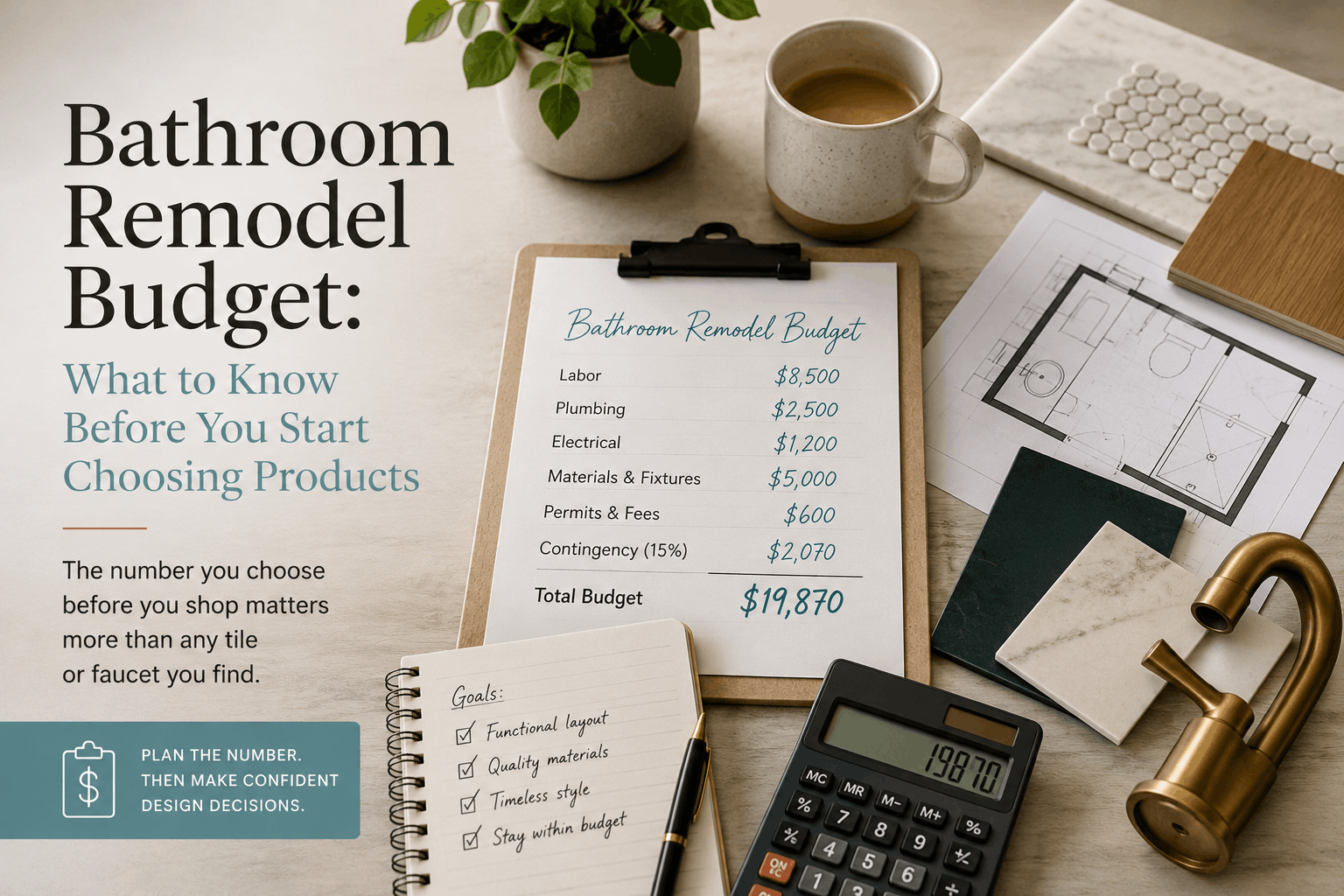








The number you choose before you shop matters more than any tile or faucet you find.
By Your Bathroom Planner | Practical Bathroom Remodel Planning Guidance
Most people start their bathroom remodel by looking at tile.
Or they fall in love with a faucet on Instagram. Or they spot a vanity at a home show and start building a budget around what that one piece costs.
That approach gets expensive fast.
Here is the honest answer to the question so many homeowners ask before they start: your budget should come before your product choices, not after them. Not even a little bit after. Your number should exist before you walk into any showroom, click on any website, or add anything to a wish list.
Why? Because the budget shapes every decision that follows. It tells you which materials make sense. It tells you whether you can move plumbing or whether you are better off working with what you have. It tells you if a gut remodel is even on the table, or if a cosmetic refresh is the smarter starting point.
Without that number, you are not planning. You are shopping. And there is a real difference between the two.
The national average bathroom remodel now runs between $12,000 and $16,500, with the full range for complete remodels stretching from $6,000 to $45,000 depending on the size of the bathroom, the scope of the project, the quality of fixtures and materials, and where you live. That is a wide range. Your job before you start choosing products is to figure out which part of that range you are actually working in.
Key Takeaways
- Your budget should be set before you start choosing tile, faucets, vanities, or finishes
- The national average for a bathroom remodel is $12,000–$16,500, with the full range spanning $6,000–$45,000
- Labor typically makes up 40–65% of total project cost — that number changes what you can afford in materials
- Small bathrooms cost more per square foot than large ones because fixed costs do not shrink with the room
- Build a 15–20% contingency into your number before you commit to any product selections
The Problem
Here is what happens when homeowners skip the budget conversation.
They fall in love with a shower system that costs $4,000. They find tile they love at $18 a square foot. They spend three weekends collecting inspiration images, pinning faucets, looking at vanities, and building a mental picture of a beautiful bathroom.
Then they call a contractor.
And the estimate comes in at $38,000.
And they are shocked, because nothing in the process warned them this was coming.
I have watched this happen more times than I can count. Not because the homeowner did anything wrong. But because nobody told them that the products they were choosing and the labor and materials required to install them properly were two completely different budget conversations.
The tile you see on the showroom floor has a price tag. But behind that tile is waterproofing. And behind the waterproofing is demo. And behind demo is disposal. And sometimes behind the wall is a plumbing problem nobody knew about until they opened it up.
The fixtures you love have prices. But installation costs money. Rough-in parts cost money. Supply lines cost money. Valves cost money. And if your contractor discovers that the existing plumbing does not match what the new fixtures require, that conversation is going to happen after you have already committed.
None of this means you should be afraid of remodeling. It means you should start with the number before you start with the tile.
Because when you know your budget first, everything else becomes easier to sort through. You can look at a $4,000 shower system and say: “That is not where my money needs to go right now.” Or you can say: “That is the thing I care most about, so let me find other places to keep costs in check.”
Budget clarity creates decision clarity. And that is the thing that makes a remodel feel manageable instead of overwhelming.
The Evidence
Let’s talk about what the numbers actually look like.
The national average for a bathroom remodel in 2026 is roughly $12,000–$16,500. But that average does not tell you much on its own. The more useful information is what drives the cost.
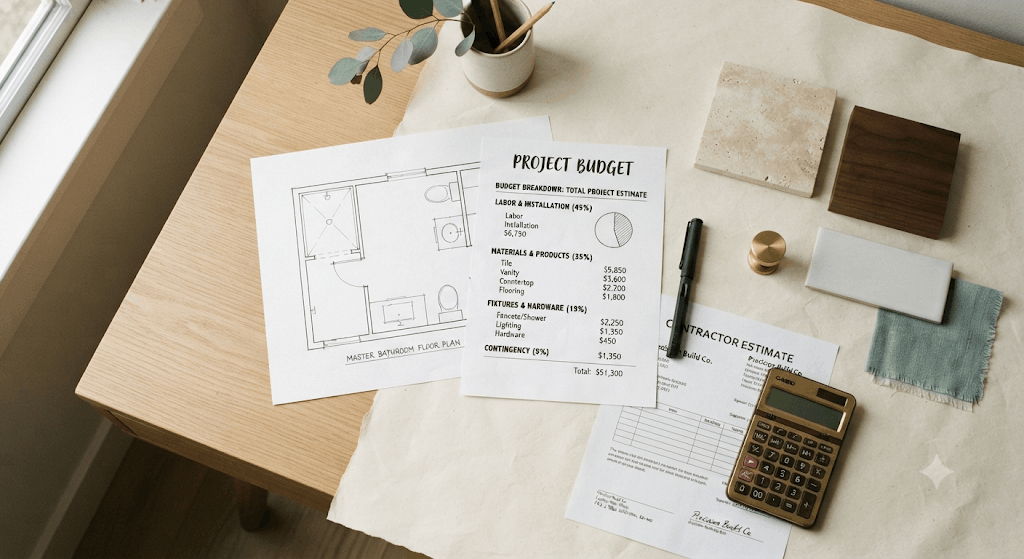
Labor makes up between 40% and 65% of the total project cost in most bathroom remodels. That means if you have a $15,000 budget, somewhere between $6,000 and $9,750 of that money is going to skilled trades — the plumber, the tile setter, the electrician, the general contractor managing the job. What remains is your actual product and material budget.
That shifts the math significantly.
Plumbers in 2026 charge between $85 and $175 per hour. A plumbing-heavy bathroom can eat up a meaningful portion of your budget before a single tile goes on the wall.
Small bathrooms are a specific area where budget expectations often fall short. The most common assumption homeowners make is that a small bathroom should be cheap to remodel because the room is small. But small bathrooms still require plumbing, electrical, waterproofing, tiling, fixture installation, and labor — all of the same fixed-cost work that goes into a larger bathroom. The cost per square foot for a small bathroom often runs higher than a larger space because those fixed costs are spread across fewer square feet.
A standard 5×8 bathroom typically runs $6,000–$12,000 for a full remodel, and can reach $15,000 or more when a gut remodel or plumbing relocation is involved.
Industry professionals consistently recommend building a 15–20% contingency into your budget before you commit to any product selections. That is not a cushion for indecision. That is a buffer for what gets discovered after demo starts — hidden water damage, outdated plumbing, rotted subfloor, code upgrades. These are not rare. They happen in a significant portion of older home remodels.
About 1 in 3 homeowners who recently completed a bathroom remodel reported that the final cost was higher than expected. The most common reasons: plumbing upgrades, water damage, and structural issues uncovered after the walls were opened.
The homeowners who stayed on budget were not lucky. They were prepared.
The Solution
So how do you actually set a budget before you start choosing products?
Start with the goal.
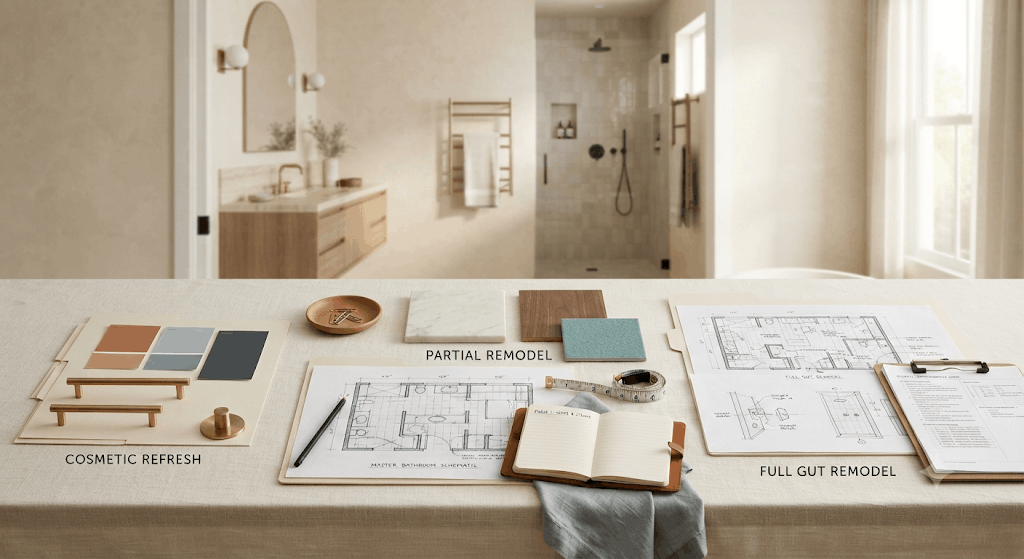
Before any number matters, you need to know what you are actually trying to accomplish in this bathroom. Are you doing a cosmetic refresh — new fixtures, paint, maybe tile? Are you doing a partial remodel where the layout stays the same but the surfaces change? Or are you doing a gut remodel where everything comes out and the plumbing may move?
Each of those scopes has a very different budget range. If you do not know which one you are planning, you cannot land on a number that makes sense.
Here is the framework Your Bathroom Planner uses – the Confident Bathroom Plan Method:
Step 1: Clarify the Remodel. What are you changing? What has to stay? What do you know you want? Get specific. “New bathroom” is not a scope. “New shower system, new vanity and sink, new toilet, and updated tile without moving any plumbing” is a scope.
Step 2: Check the Compatibility. Once you know what you want to change, you can start to understand what those changes require behind the walls. New shower system? You may need to look at the valve. New tile? You need to account for waterproofing and demo. This step is where fixture and product decisions start connecting to real budget numbers.
Step 3: Control the Decisions. Set your number before you shop. Choose your must-haves first. Then add nice-to-haves only if the budget supports them. Build your 15–20% contingency in from the start so it does not catch you off guard later.
A practical starting point: if you have a $15,000 budget, expect $6,000–$9,000 to go to labor and installation, leaving $6,000–$9,000 for fixtures, tile, vanity, and materials. That product budget needs to cover everything visible — and everything that makes the visible pieces work.
Knowing that breakdown before you fall in love with a $1,800 shower head changes the conversation quickly.
The homeowners who remodel without budget shock are the ones who did this math before they started shopping. They made their fixture decisions inside a real number, not outside of it.
Frequently Asked Questions
How much should I realistically budget for a bathroom remodel in 2026?
Most homeowners spend between $12,000 and $16,500 for a standard bathroom remodel, with full gut remodels and master baths running $20,000–$45,000. Small bathrooms (5×8) typically run $6,000–$12,000. Your range depends on scope, materials, and your local labor market.
Should I budget for labor separately from materials and fixtures?
Yes. Labor typically makes up 40–65% of total project cost. If you budget $15,000, plan for $6,000–$9,750 going to the contractor, plumber, electrician, and tile setter before materials enter the conversation.
What happens if I do not have a budget set before I start choosing products?
You end up choosing products based on what you love instead of what the full project can support. That leads to scope creep, contractor surprises, and having to backtrack on selections once the real cost becomes clear.
Why does a small bathroom cost more per square foot than a large one?
A small bathroom still requires plumbing, electrical, waterproofing, tiling, and labor — the same fixed-cost work as any bathroom. Spreading those fixed costs across fewer square feet pushes the cost per square foot higher.
How much contingency should I add to my bathroom remodel budget?
Industry professionals recommend 15–20% above your primary budget. This covers hidden issues uncovered after demo: water damage, outdated plumbing, rotted subfloor, or code upgrades. One in three homeowners report going over budget — a contingency makes that survivable.
The Close
Here is what I want you to hear.
You do not have to figure all of this out perfectly before you take a single step.
But you do need a number before you start choosing products. Not a guess. Not a wish. A real, thought-through number that accounts for labor, materials, your must-haves, and a contingency for what gets found in the walls.
That number is the difference between a remodel that stays manageable and one that becomes a financial stress you were not expecting.
The tile, the faucet, the vanity – all of those decisions are easier when you already know what they can cost.
Start with the goal. Know your number. Then go shopping.
A budget is not a constraint on your dream bathroom. It is the thing that makes your dream bathroom actually happen.
Your Bathroom Planner translates real-world plumbing showroom and product specification experience into plain-English bathroom planning guidance. The brand helps homeowners avoid costly mistakes, understand fixture compatibility, and make smarter decisions before construction begins.










+ show Comments
- Hide Comments
add a comment